Table of Content:
-CHAPTER 1: THE IMPORTANCE OF PARTNERING
This chapter details the importance of associations, the advantages and benefits of joining them for individuals with low vision, and how associationism fosters a more inclusive society.
-CHAPTER 2: HOW TO CREATE YOUR ORGANIZATION
This section aims to provide simple guidelines for establishing a new organization. In this way, young people with low vision can understand the context and tasks involved in creating a new entity.
-CHAPTER 3: THE STRUCTURE OF AN ORGANIZATION FROM THE BOARD OF DIRECTORS TO THE TECHNICAL TEAM
Thanks to this section, readers of the guide can understand the entire organizational structure of an entity, from the direct team that issues orders to the technical team that works to ensure that those orders are fulfilled.
-CHAPTER 4: METHODS FOR WORKING IN AN ASSOCIATION: NETWORKING.
This section outlines the ways in which a social entity operates, promoting networking so that all young people with low vision worldwide can work towards inclusion.
-CHAPTER 5: ACTION PLAN.
Once the entity is formed, it should have a mission, vision, and values. Therefore, this chapter provides clarity on the objectives that an entity should have and how it can achieve them through good strategic planning and facilitating mechanisms.
-CHAPTER 6: WAYS TO MAKE YOUR PROJECT A REALITY: THE E+ PROGRAM.
With the objective of the entity clear, it is necessary to seek the path to make it a reality. At this point, the discussion revolves around the possibilities that entities have to carry out their strategies and how Erasmus+ assists in this endeavor.
-CHAPTER 7: CONCLUSIONS.
-CHAPTER 8: ACKNOWLEDGMENTS.
-CHAPTER 9: AUTHORS.
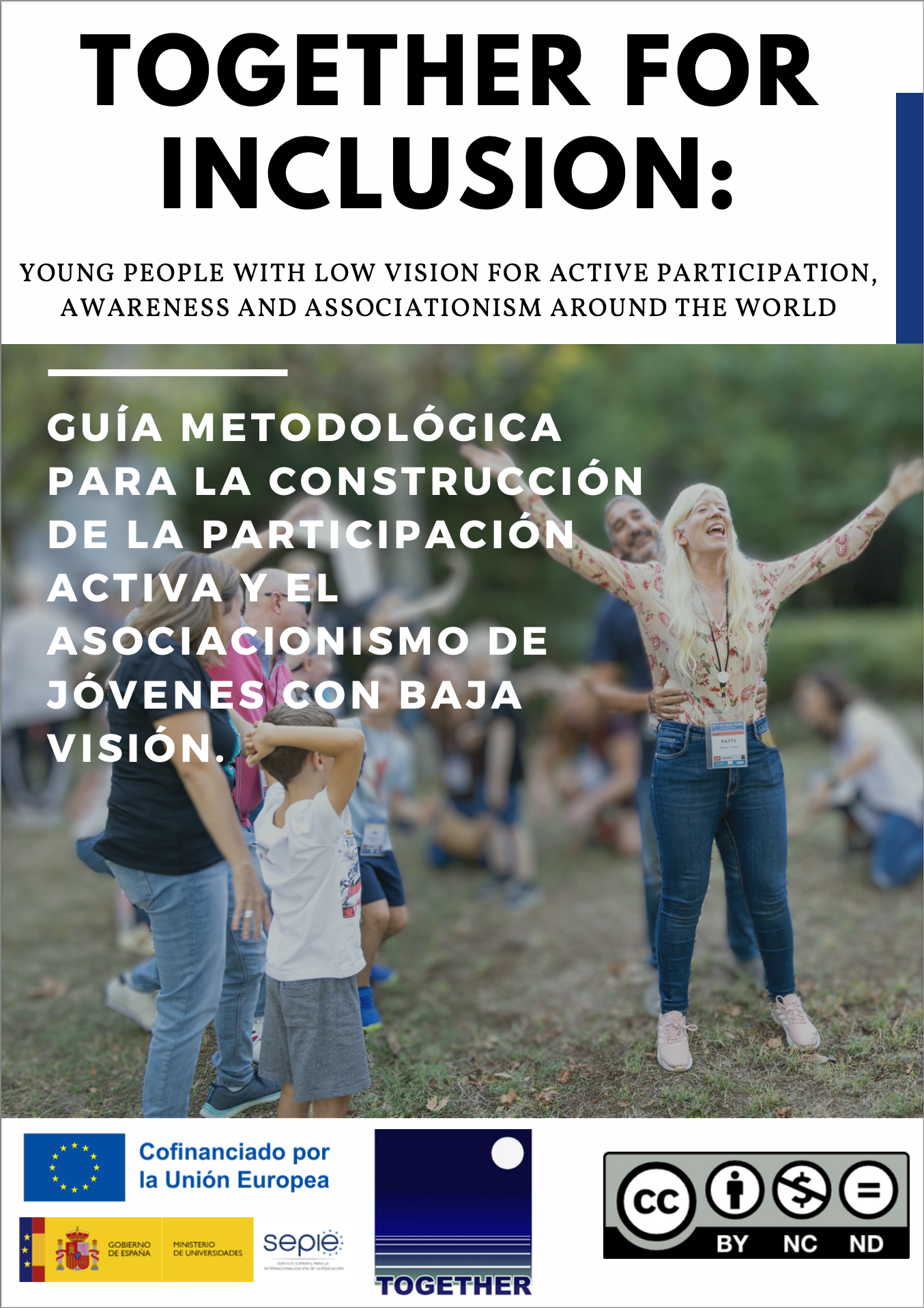
TOGETHER FOR INCLUSION: YOUNG PEOPLE WITH LOW VISION FOR ACTIVE PARTICIPATION, AWARENESS AND ASSOCIATIONISM AROUND THE WORLD. Methodological Guide for Building Active Participation and Associationism among Young People with Low Vision © 2024 by ALBA Asociacion is licensed under CC BY-NC-ND 4.0
Table of Content:
-MODULE 1: INTRODUCTION
-MODULE 2: PREPARATION
-MODULE 3: EFFECTIVE COMMUNICATION
-MODULE 4: COLLABORATION PROPOSAL
-MODULE 5: RAISING RESOURCES AND SUPPORT
-MODULE 6: MONITORING AND EVALUATION
-MODULE 8: CONCLUSIONS
-MODULE 9: ACKNOWLEDGMENTS
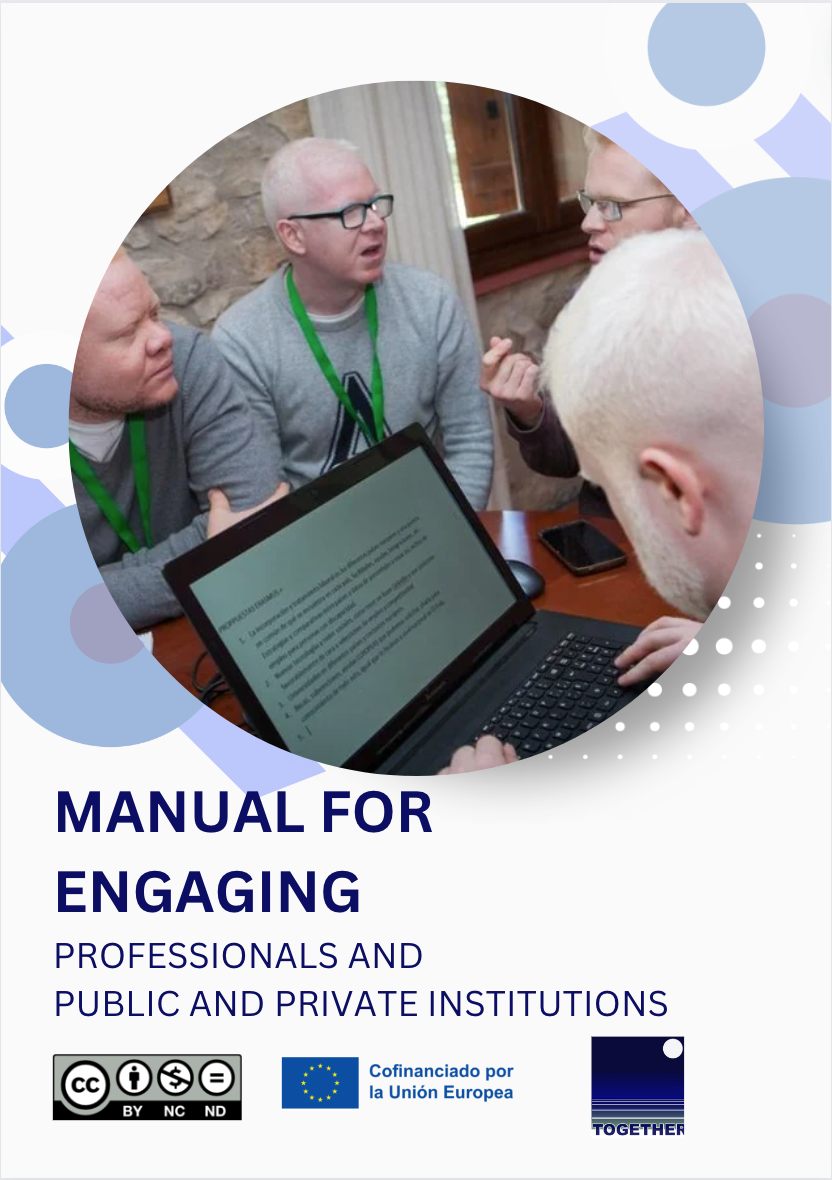
TOGETHER FOR INCLUSION: YOUNG PEOPLE WITH LOW VISION FOR ACTIVE PARTICIPATION, AWARENESS AND ASSOCIATIONISM AROUND THE WORLD. Manual for Engaging Professionals and Public and Private Institutions © 2024 by ALBA Asociacion is licensed under CC BY-NC-ND 4.0
SHORT DOCUMENTARY: YOUNG PEOPLE OVERCOMING BARRIERS, BUILDING THE FUTURE © 2024 by ALBA Asociation is licensed under CC BY-NC-ND 4.0
In this first segment, you will learn what low vision is and what it entails, presented by ophthalmologist Honorio Barranco, an albinism specialist at La Fe Hospital in Valencia. Additionally, Matteo CastelNuovo, Vice President of Aniridia Italiana, will provide further explanation about low vision. Lastly, you’ll hear testimonies from individuals with albinism, including Andrea, Gabriel, and Mauricio, who will share tips on how to manage and support low vision.
In this second segment, which addresses the causes of albinism and aniridia—two genetic conditions classified as rare diseases—you will hear from genetic specialist Dr. Lluis Montoliu, who will explain these conditions. Additionally, you will listen to testimonies from individuals with albinism and aniridia, such as Claudia Nuñez, Vicepresident of Albinos Chile, Pietro from Aniridia Italiana, and Emma and Jessica from Aniridia Europe, sharing their daily experiences.
This segment will help you understand how to work with a young person with low vision. We will hear from Corrado Teofili, President of Aniridia Italiana, who will explain the key points to keep in mind. We will also hear from Carolina González, President of Albinos Chile, who will discuss adaptations for students with low vision. Lastly, you’ll get advice from Claudia, Jessica, and Bea on how to adapt workspaces and make use of technologies for low vision.
Continuing from the previous topic, in this segment you will learn about activity adaptation strategies for young people with low vision, led by highly experienced professionals in the field, such as teachers and educators.
Here, you will learn how to digitalize organizations and understand the importance of volunteers. We have Pepe Solves, Vice President of ALBA, who will discuss the use of technology for low vision. Additionally, we will hear from Camila, Carolina, Gabriela, and Jordi, who are part of volunteer work and organizations focused on low vision, to highlight the significance of volunteers.
Thanks to this topic, you will learn how to engage young people in organizations, as well as the importance and necessity of including them. To discuss this, we have Daniel Soria, the secretary of the organization Simplemente Amigos, along with Esteban and Marta, who will explain the importance of associationism and organizations. Lastly, you will hear from Carolina, a young woman with albinism, who will share her experience of how she gets involved in an organization.
To conclude, Bea, a young woman with albinism, presents the webinar’s final remarks, emphasizing the importance of associationism and social organizations, which play a crucial role in promoting inclusion and breaking down barriers to create a better world.
WEBINAR-COURSE FOR YOUTH WORKERS TO DIGITALIZE WORK IN NON-FORMAL AND INFORMAL EDUCATION WITH YOUNG PEOPLE WITH VISUAL DISABILITIES © 2024 by ALBA Asociation is licensed under CC BY-NC-ND 4.0